SEO, GEO and AEO may look like a new mix of acronyms, but they all serve one purpose: making sure your content is discoverable across search engines, AI Overviews, and generative AI platforms. Just as SEO is a powerful organic source that brings sustainable and high-quality online traffic, GEO and AEO are too if done right.
At Paved Digital, we’ve seen dramatic shifts in organic traffic across Google Analytics and Search Console of our brand and our clients this year. Users are shifting from typing keywords into Google to asking conversational questions on ChatGPT. Many expect direct answers without having to click on those blue links and read the full content.
Key industry signals
Featured snippets and AI Overviews now appear in nearly half of all Google searches (source)
Gartner predicts a 25% drop in traditional search volume by 2026, and a potential 50% drop in organic traffic as consumers shift to AI search.
Google Lens processes 20 billion search queries each month, with 1 in 4 having commercial intent (Think With Google).
What you’ll learn in this article
What SEO, GEO and AEO mean and why they matter
What SEO, GEO and AEO have in common
Four key differences between SEO and GEO/AEO
How Paved Digital helps brands win across all three channels
SEO, GEO and AEO Definitions
SEO: Optimises your website for traditional search engines like Google and Bing.
GEO: Optimises your content for generative engines (ChatGPT, Gemini, Perplexity) so they use your content in responses.
AEO: Optimises content for answer extraction, including AI Overviews, featured snippets and direct answers.
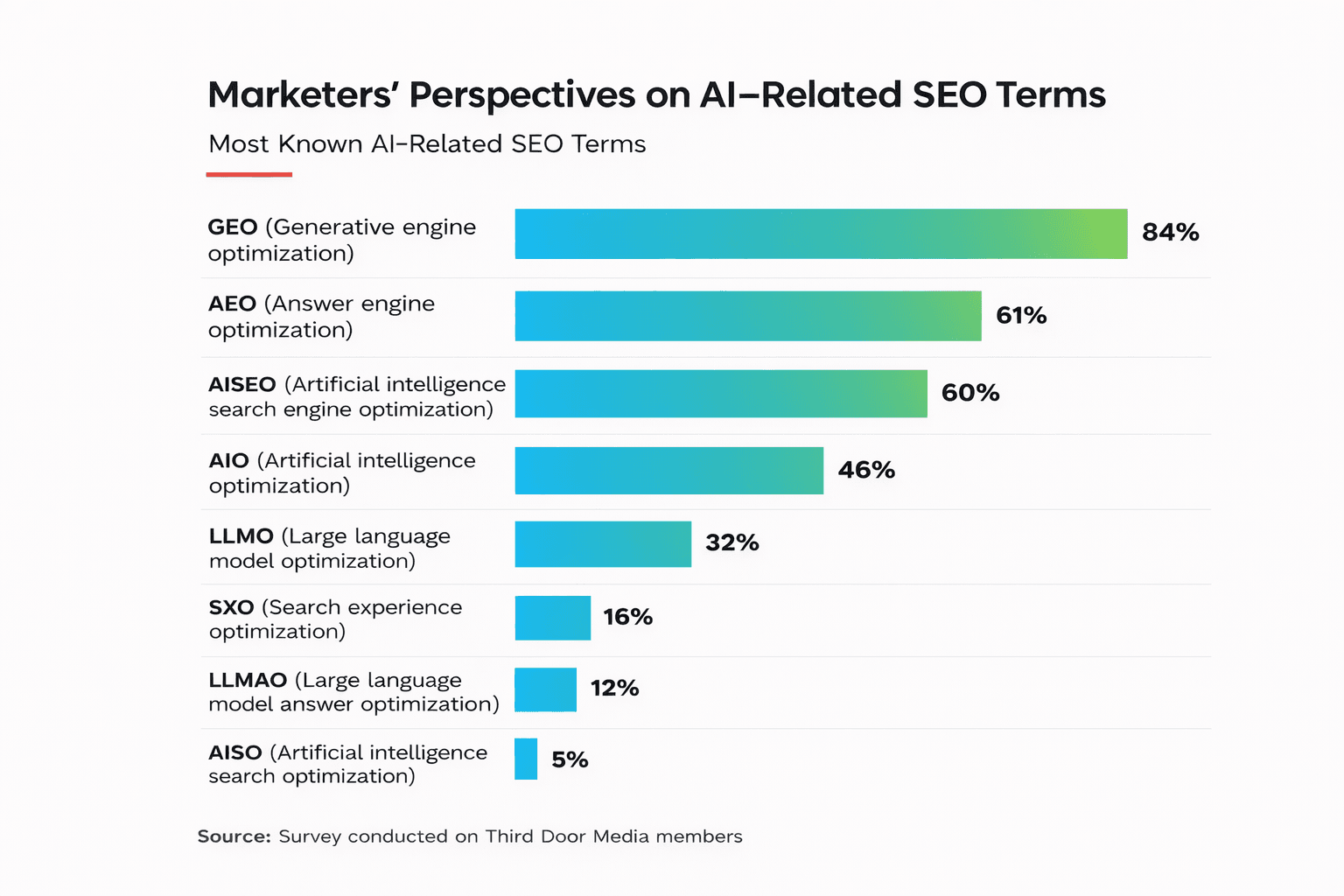
With these definitions in mind, it’s useful to look at how familiar marketers are with these terms in practice.
The chart below shows marketers’ awareness of common AI-related SEO terms.
Why is GEO important in 2026?
Users aren’t (yet) abandoning Google Search for ChatGPT, Gemini and other AI chatbots. According to a recent Sparktoro and Datos research:
Google handled 373 times more searches than ChatGPT in 2024
The number of Google searches grew 21.64% in 2024 compared to 2023
Only 30% of ChatGPT prompts were search-like
Even if all ChatGPT’s 1 billion messages per day were search-related, its market share is still less than 1%.
However, the shift toward AI search is accelerating far faster than expected. The new Q2 2025 data tells a different story already. Generative AI now accounts for nearly 1 in 10 digital queries, and that number is rising quarterly:
Platform | Monthly Active Users (Global) | Share of Total Digital Queries | Avg. Session Duration |
|---|
Google Search | 4.9 billion | 81.6% | 5m 12s |
ChatGPT | 542 million | 9.0% | 14m 9s |
Other (e.g., Bing, Perplexity) | 560 million | 7.4% | 4m 33s |
Table 1. The breakdown of total estimated digital query market share held by Google and ChatGPT at the end of Q2 2025
Therefore, your content must be optimised for both search engines and AI engines to stay competitive.
The intention is the same: to increase your brand awareness and visibility by serving relevant content to users.
Key overlaps include:
Relevant and trustworthy content
Clear topical authority
Structured content formats (lists, tables, headings)
Strong technical foundation of your site (speed, crawlability, indexability, mobile user experience)
Internal linking that builds semantic relationships
Structured content or schema markups to help machines understand your content
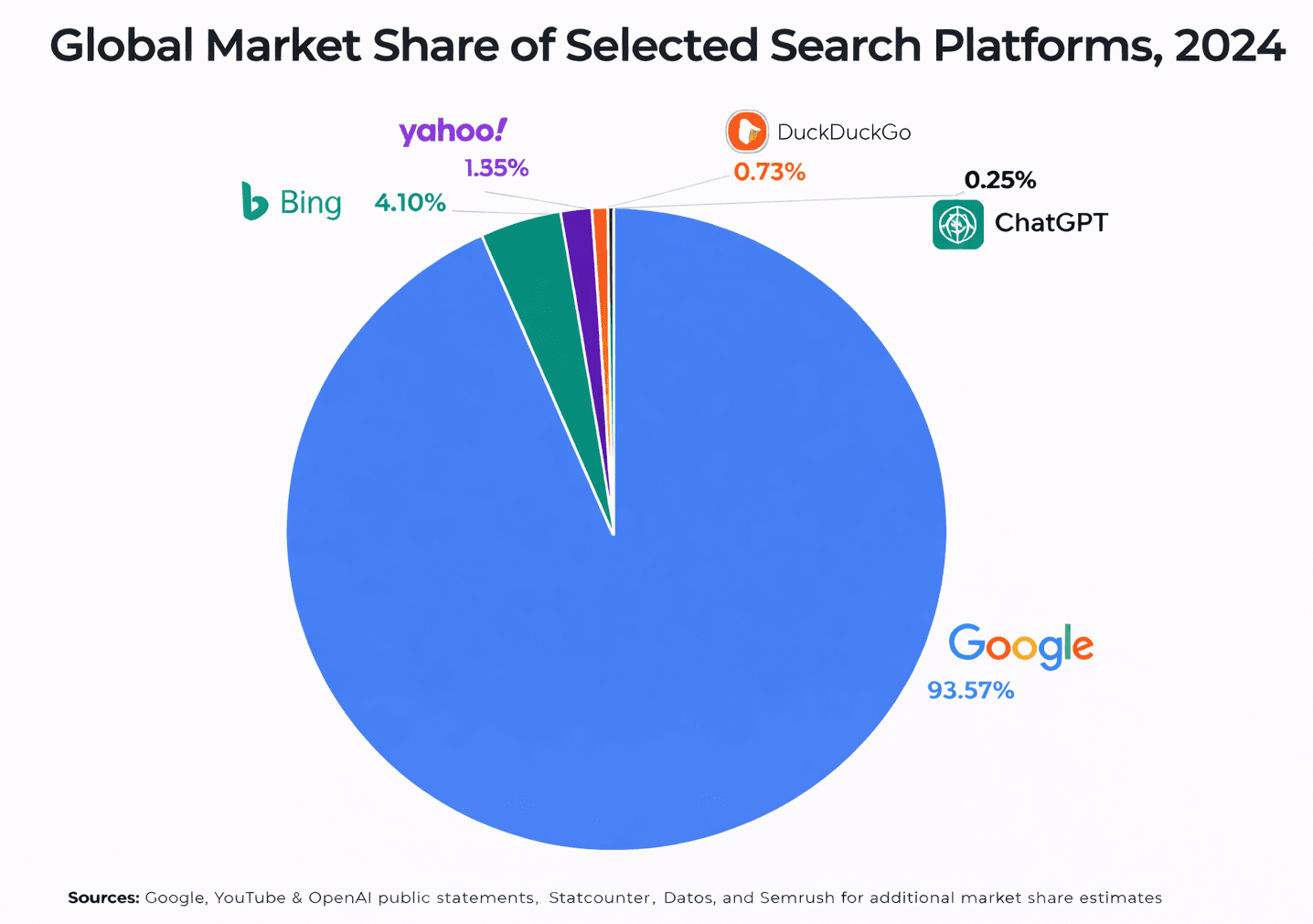
While SEO, GEO and AEO share the same underlying principles, they are applied across different surfaces. Traditional search engines still dominate how users discover content today.
The chart below shows the global market share of major search and AI-driven platforms in 2024.
If your website is well optimised for search engines, it provides a strong foundation for GEO and AEO. However, additional optimisation is needed to win AI-generated answers.
1. Topic relevance vs. keyword optimisation
AI Overviews behave differently from traditional search results (Ahrefs):
AI Overviews appear for 21% of all keywords
AI Overviews results change every 2.15 days
45.5% of the cited sources are entirely new daily
Even if your content gets cited in AI overviews, your brand mention can be gone the next day. Such volatility means you must focus less on keyword ranking and more on topic authority. Instead of optimising content for exact phrases or keywords, in GEO/AEO, you want to become an authority on the themes associated with your core topics.
AI Overviews also favour conversational language and question-and-answer types of content. When creating content for GEO/AEO, think of the actual questions your customers may ask and write to answer those in clear, conversational and direct languages.
2. Data source citation vs backlink
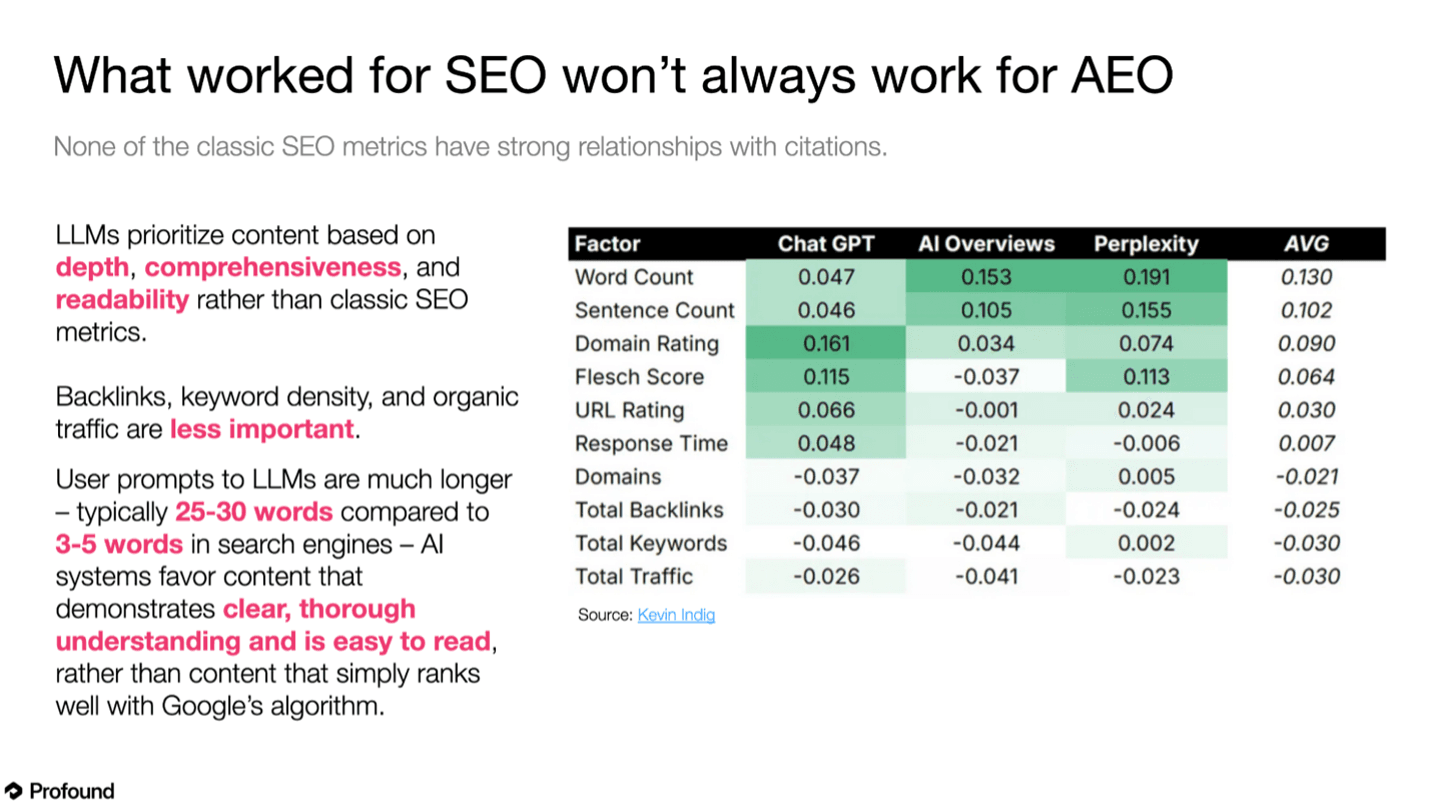
Backlinking in SEO helps build your brand’s authority, credibility and trustworthiness. Unmentioned backlinks are worthless in SEO. Yet LLMs understand the brand’s authority from actual words on the page, so unlinked mentions are still valuable for AEO/GEO. Credible third-party references help your brand become more visible, with or without clickable links.
Look for opportunities to get mentioned alongside your competitors, in industry surveys and research studies, as well as in online communities such as Reddit and LinkedIn. The more often your brand shows up in relevant contexts across the web, the more likely AI engines will include your brand and your content in their responses. Additionally, AI loves stats! Content pages with quotes or statistics have 30 to 40% higher visibility in AI answers.
3. Structured content and content chunking
Systems process information differently than humans do. They break content into chunks to analyse them. Each chunk or paragraph should be 100 to 300 words, with clear semantic boundaries, so that AI engines can extract clean and accurate responses.
AI assistants don’t read a page top to bottom like a person would. They break content into smaller, usable pieces, a process called parsing. These modular pieces are what get ranked and assembled into answers.
Krishna Madhavan, Principal Product Manager @ Microsoft Bing
The usual SEO practices of optimising title, description, H1s and other headings remain effective for GEO/AEO. The use of HTML elements like lists and tables, or question and answer pairs are all good content format for GEO/AEO. However, instead of relying solely on sitemap and robots.txt, AEO/GEO uses llms.txt, which is a proposed standard for helping LLMs access and intersect structured content from website in a markdown document format with specially formatted text.
Common content chunking mistakes to avoid
Avoid using long sections with walls of text. Don’t break your content down into tiny, fragmented chunks either. Your headings, from H1 to H2, H3, H4, should be used logically and properly, allowing readers to scan content.
4. Metrics and tools to use for SEO/GEO/AEO
While SEO, GEO and AEO share common foundations, they differ in how visibility is achieved and how success is measured. The sections below outline the key focus areas, metrics and tools used across each discipline.
| SEO | GEO | AEO |
|---|
Content Visibility | SERPs | Generative AI Engines | Featured Snippets, AI Overviews |
Content Strategy | Optimise for crawling and ranking | Optimise for LLM understanding and topic authority | Optimise for answer extraction |
Metrics | Organic search traffic Keyword position Keyword CTR Number of backlinks Domain Authority Technical SEO score | AI engine visibility score Brand citation frequency Topical authority score AI generated traffic | AI Overview appearance rate Featured snippet ownership People Also Ask coverage Q&A block extraction success Snippet CTR Answer match score |
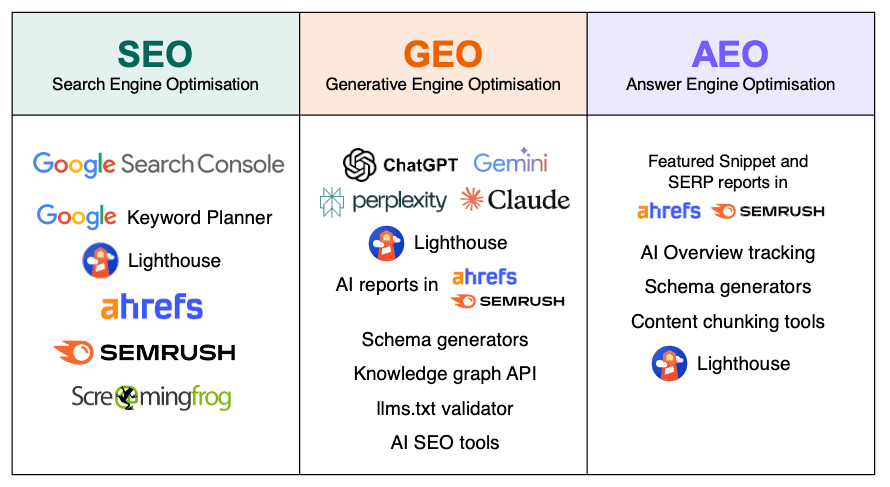
Commonly used tools are shown below.
Paved Digital is an Australian digital agency specialising in SEO, AI visibility (GEO), and Answer Engine Optimisation (AEO), helping brands increase organic and AI-driven visibility across Google, ChatGPT, Gemini, Claude, Deepseek, Perplexity and more. We combine AI-powered optimisation, data intelligence, and full-funnel user-journey design to drive real business growth.
Our approach ensures your brand gets found, selected and converted across both traditional search engines and the new generation of AI-driven search platforms. Contact us today for a full audit of your website.