In the second quarter of 2026, global digital traffic grew 18% year on year, but orders grew just 1%, according to Salesforce's holiday predictions. Shoppers are visiting, comparing and asking AI for advice more than ever. They're just more careful about when, and how much, they buy.
To see what that means for this year, we looked at the latest holiday forecasts alongside our partner Contentsquare's Peak Season 2026 Digital Experience Benchmarks report. It compared more than 2,000 retail websites across 71 countries over the last two holiday seasons. Five trends stand out.
The holiday season keeps starting earlier. Adobe expects US shoppers to spend $95.8 billion online in October alone, up 8% on last year, as early sales events pull shopping forward.
But browsing early isn't the same as buying early. In early October last year, traffic briefly ran ahead of the year before, but shoppers held off buying. When shopping picked up in November, it picked up four days later than in 2024. Once shoppers decided, though, they bought fast: conversion hit its high a day earlier than the year before. Then it was over. After Cyber Monday, conversion dropped straight back to its usual level, and December ran 5 to 10% behind the previous year.
📌 Shoppers research early and commit late. The window to convert them is shorter than the calendar suggests.
More shopping journeys now start with an AI shopping assistant rather than a search box or a retailer's homepage. Salesforce says shoppers' reliance on AI as their first stop grew 200% in a year. It predicts that 20% of holiday ecommerce traffic this year will come from AI agents. That covers everything from shoppers' assistants answering questions to bots comparing prices. It's a shift often called agentic commerce.
It's not just a US story. In Australia, 62% of shoppers expect to use AI for at least one holiday shopping task this year, from finding deals to discovering products, according to Shopify. The same research links AI use with smaller brands. Among Australians who almost always use AI to shop, 80% say they're choosing independent or niche brands more often. That's double the rate of those who don't use AI to shop. And AI referrals are improving fast: Contentsquare found their conversion rate rose 55% in a year, the only channel to grow.
📌 If an AI assistant can't understand your product page, it can't recommend it.
Mobile now carries almost 80% of traffic on the busiest sales days, and that share is still growing. But desktop still punches above its weight, converting at 4.5% compared with 2.4% on mobile, with bigger orders too, averaging US$202 against US$154.
But mobile is catching up. Compared with the year before, mobile's conversion rate on those days edged up from 2.34% to 2.41%, while desktop's slipped slightly. With most shoppers already on their phones, every improvement on mobile counts for more.
📌 Most of your shoppers are on mobile. Desktop shoppers are still more likely to buy. Neither can be an afterthought.
When the big sales arrive, shoppers are ready to buy: last year, conversion rates roughly doubled on both desktop and mobile. But shoppers spent less per order than in October: around 17% less on desktop and 11% less on mobile. Revenue per visit still rose sharply, because more visits turned into sales.
Australia showed the trade-off more starkly than any other market. Conversion jumped 64% over the Black Friday to Cyber Monday weekend, while the average order fell 39%, the biggest drop of any market in the report. Shoppers here are watching their budgets closely: more than half of Australians (54%) say economic conditions have affected their holiday plans.
📌 When the sales hit, growth doesn't come from bigger baskets. It comes from helping more ready-to-buy shoppers finish what they started.
Not every category gets the same return from the big sales. Electronics and fashion both saw a bigger lift than the year before. Luxury went the other way, with fewer shoppers buying in the lead-up.
Markets differ just as much. North America's conversion rate jumped 86% over Black Friday and Cyber Monday and the UK's rose 48%, while Japan's barely moved. That's because the biggest sales moments differ from place to place. Australian retailers expect more than half of their holiday revenue to come from Click Frenzy, Black Friday and Cyber Monday. In New Zealand, clothing spending generally peaks on Boxing Day, according to Worldline. And in parts of Asia, events such as Singles' Day matter more than Black Friday.
📌 There's no single peak season. There's your peak season, and it depends on what you sell and where you sell it.
The window is shorter, so readiness matters more. With shoppers buying later and stopping sooner, there's less time to spot and fix issues once the sales start. Whatever isn't ready beforehand is likely to stay that way until the sales are over.
Your product information is doing more of the selling. Shoppers are researching through AI assistants, comparison sites and other screens before they reach your site. By the time they land, many have already made up their minds. Clear, complete and consistent product information is what gets you onto their shortlist in the first place.
The biggest sales are won on conversion. When shoppers arrive ready to buy and spend less per order, every extra step, unclear offer or slow page costs more. The biggest gains come from clearing the way between a ready shopper and the checkout, not from chasing more traffic.
The biggest sales moments look different for every business. Whether you're preparing your business for Black Friday, 11.11 or Boxing Day, the work follows the same rhythm.
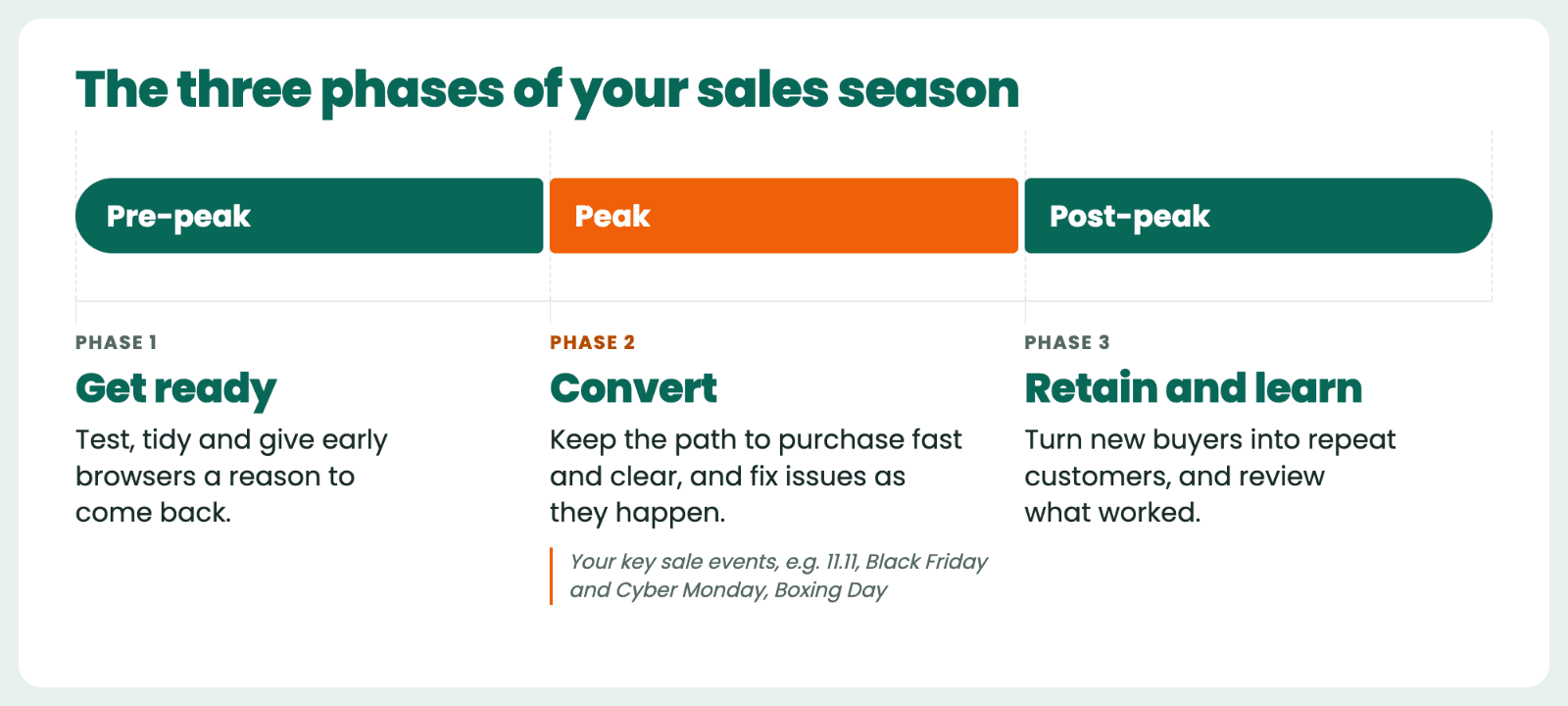
1. Test the full journey before the rush. Walk through your key journeys on real devices, from landing page to search, product page, cart and checkout. Check how the site performs under heavy load. Anything you sort out now is one less thing to manage mid-sale.
2. Make product information complete and easy for machines to read. Specs, sizes, stock levels, delivery and returns should be stated plainly on the page. Keep your product structured data (price, availability, reviews) up to date, so search engines and AI assistants can read your pages accurately.
3. Give early browsers a reason to come back. Gift guides, wish lists, saved carts and deal previews keep researchers engaged until they're ready to buy. They also help shoppers arrive at the sale with products already chosen.
4. Agree a change freeze and a fast-fix plan. Decide when the site locks down, what can still change during the sales, and who signs off urgent fixes. Make sure everyone who can touch the site is on the same page, including marketing, your development partner and third-party vendors.
💡 Tip: If you use GA4, check the new AI Assistant channel is showing in your reports before the sales start. On other analytics tools, set up a custom channel or segment for AI referrals. Either way, treat it as a minimum: visits from AI apps often arrive without a referrer and show up as Direct.
1. Make offers easy to understand. Confusing pricing or discount terms hold shoppers back. Make the deal, the conditions and delivery cut-off dates clear, and put your most popular categories front and centre on sale landing pages.
2. Watch in real time and fix what costs the most. Keep an eye on conversion by device and on your key journeys. Not every issue deserves equal attention while the sales are on, so prioritise the ones with the biggest impact on revenue.
3. Plan for bots as well as shoppers. Part of your traffic will come from AI agents and price-comparison bots. Make sure your site can handle the extra load, and don't read every spike in traffic as demand.
💡 Tip: Run through this for every major sale event in your calendar, not just the biggest one.
Post-peak: retain and learn
1. Shift spend into retention. Don't count on a late surge after your main events. Turn new buyers into repeat customers with welcome journeys, loyalty offers and personalised follow-ups across your channels.
2. Review mobile once the deals finish. Sale urgency can make mobile look stronger than it is. Look at where mobile shoppers hesitated or dropped off once the pressure of the sale is gone and improve for everyday behaviour.
3. Capture what worked, by category and market. While it's still fresh, record which offers, pages and channels performed, and where. It's the best starting point for next year's plan.
💡 Tip: Book your review into the calendar before things get busy.
Fast pages, clear product information, a smooth checkout and data you can trust make the difference when shoppers arrive ready to buy.
At Paved Digital, this is what we help retailers with. We build and improve ecommerce sites, optimise conversion, set up analytics, and make sure products are easy to find in search and AI. We're a technology agency with a business mindset, and we work with any platform and tech stack, so we start from what you already have.
Want to see where we can help? Talk to our team about making the most of your biggest sales moments.