The first thing that we do when Paved Digital approaches a new prospect, or when a new client joins us, is to audit their sites. We would ask for access to Google Analytics, Google Tag Manager, Google Search Console, Adobe Analytics, their CRM and CDP if available, then analyse their metrics such as:
Traffic (number of sessions/users)
Engagement rate
Pages per session
Average time on site
Daily Active Users (DAU) and Monthly Active Users (MAU)
Returning user rate
The keywords they are ranking for: search volumes, ranking positions and clickthrough rates (CTR)
We look at trends in the last 12 months and compare to the previous period. We analyse clickthrough rates, conversion rates, purchase rates, and form submission or opt-in rates by devices, acquisition channels, new vs returning, customer groups, and more. We use Google Page Speed Insights, Screamingfrog, SimilarWeb, Ahrefs and SEMRush to audit their sites’ performance, accessibility, technical SEO, Core Web Vitals and compare to their competitors as well as the industry benchmark. We look at their key user journeys’ funnels, drop-off rates, and potential causes of drop-off. After we know what the numbers say, our digital strategists, UI/UX experts, SEO/GEO and CRO specialists will put together audit insights: key problem areas and improvement opportunities, ranked by impact and priority.
It sounds very time-consuming, but we’ve done it so many times that we know exactly what to look for. And we never skip this process because to succeed in any projects, we need to know where the client is at compared to others, and what the critical challenges are to solve to get maximum impact. This shapes the right strategy, roadmap and technology stack for our clients.
From my experience, here are the top 10 signs that your website needs optimisation:
Enter your site URL to the free Google PageSpeed Insights tool to get a website performance report. If your site is ecommerce, you may want to try different URLs, such as your Category Listing Page, Product Detail Page and Checkout as well, since product pages typically load slower than Home Page.
If your Performance Score is below 80, there might be layout shifts, large images, or redundant JavaScript slowing down the site.
Why does website performance matter? Research shows that a 0.1-second improvement in loading speed increases conversions for retail brands by 8.4%. For a $10 million turnover business, 8.4% equals $840,000 lost revenue.
If your Accessibility Score is below 80, you may unintentionally block a segment of users from engaging or converting.
Why does website accessibility matter? According to the Australian Bureau of Statistics (ABS), more than one in five people (21.4%) had disability in 2022. Failing to meet WCAG standards is a growing legal and reputational risk as well.
If your SEO Score is below 80, it’s alarming as well!
Why does SEO matter? In Australia, around 68% of all website traffic comes from organic search, so when your SEO score is below 80, you’re potentially missing two-thirds of your visibility channel. One local study also found that 85% of Australian retailers’ product pages under-perform in search, meaning these visibility issues are very real. Technical SEO gaps make it hard for AI engines to understand your content, which limits your chance to get mentioned in AI generated responses and AI Overviews.
Website performance is especially important during Thanksgiving, Black Friday, Cyber Monday and Christmas sales periods. Your hosting needs to handle traffic spikes despite the many ongoing promotions with complex logics and beautiful graphics that may slow down the site. Businesses running third-party scripts for ads or experimentation should optimise for fast website load time also.
2. More than 15% of your users landed on Search page
Why is it a big deal that many of your users actively use Search on your site?
1-5% search usage is often ideal for simple, well-designed sites, especially in B2B, service businesses websites, landing pages or corporate websites.
For content-heavy or big ecommerce sites, you’ll see 5-15% search usage.
But search usage rate above 15% is typically a sign that your site navigation doesn’t work well, and your users can’t find what they need. That is a UX red flag. You should audit your site navigation, information architecture, popular search terms and your mobile UX. Most CMS platforms have native search optimisation and insights, or you can track search behaviours using Google Analytics. Look at:
What search terms your users are using the most?
What are the clickthrough rates and drop-off rates of those search terms?
It’s not just about how many people use Search, it’s also about what happens after.
If the search refinement rate (percentage of users who search again) is more than 10%, your users probably didn’t get a good first result, meaning you should adjust the search criteria that decides which results to show when.
If the search exit rate (percentage of users who leave immediately after searching, without clicking on anything) is higher than 20%, your search results may be irrelevant or poor.
People who search tend to convert 2-5x higher because they have higher intent, so if they aren’t converting, you should optimise your content and product pages.
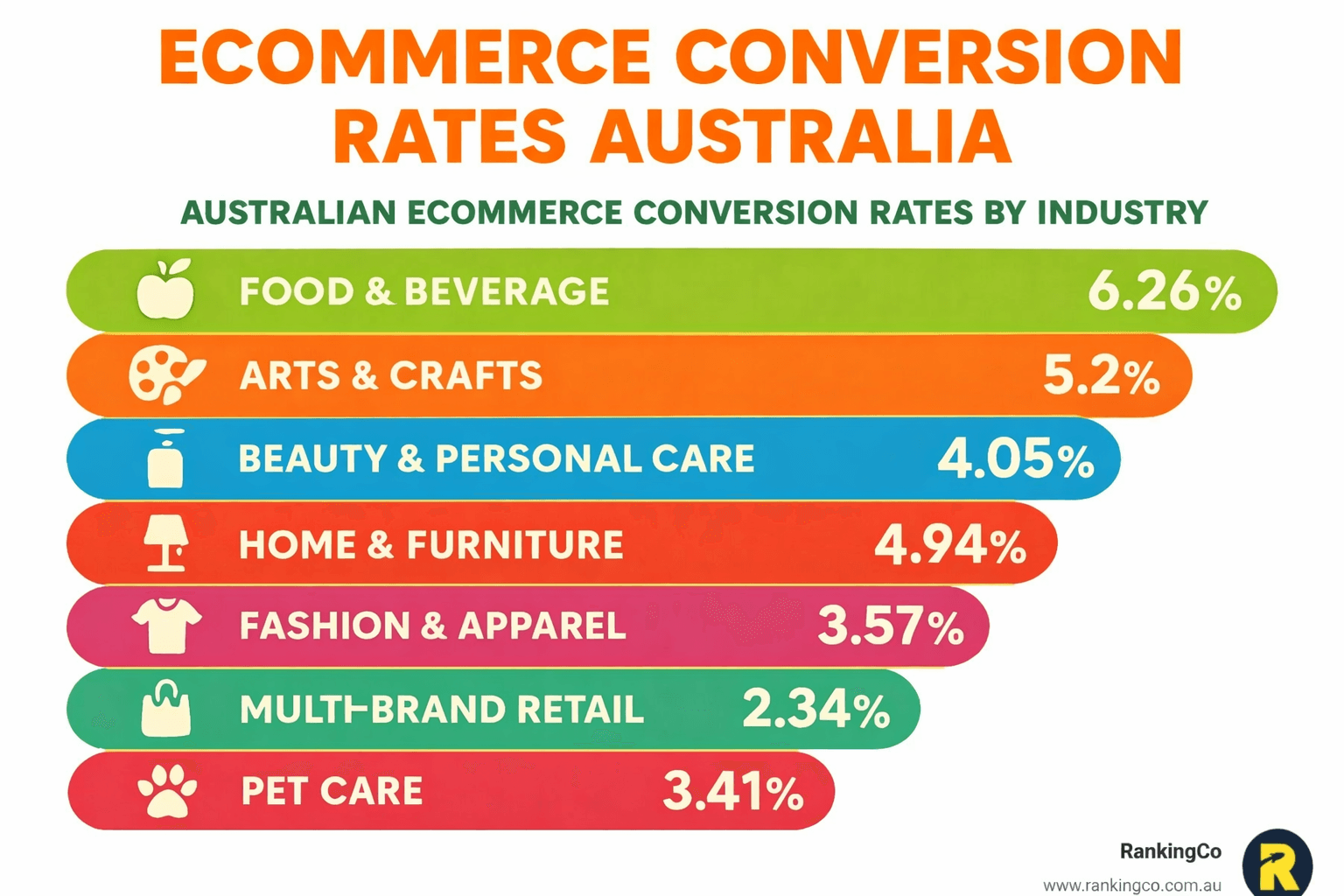
Each industry has a different benchmark for conversion rate. Ecommerce conversion rate in Australia averaged 1.78% as of September 2024, lower than the global average of 1.88%.
Conversion rate = (number of conversions / number of total website visits) x 100
Conversion rate (CVR) refers to purchases or form submissions. However, there are two types of conversion we track: primary conversion and micro-conversion:
Primary conversion: number of purchases or form submissions (for non-ecommerce businesses)
Micro-conversion: add-to-carts, checkout visits, email sign-ups, coupon claims, or product click-throughs all act as strong leading indicators of your primary conversion. They sit earlier in the funnel, so they change more frequently and are easier to influence. We use micro-conversions as KPIs for experimentation to confidently pinpoint where experiments are creating lift and validate hypotheses more reliably before scaling efforts toward improving the primary conversion.
A clear sign your website needs a tune-up is when your conversion rate sits below industry benchmarks, or when it’s been flat or sliding over the past 12 months. If things aren’t improving, it usually means there are friction points in the customer journey, such as slow load times, clunky navigation, unclear product info or a checkout that’s harder than it should be. Even if your traffic is steady, a stagnant conversion rate shows the site isn’t keeping up with shifting customer expectations or what competitors are offering. Spotting these trends early lets you act fast, run experiments and refine the experience before it starts costing you more sales.
Many mobile visits underperform compared with desktop, because friction in mobile checkout, slow load times, or poor responsiveness can all discourage people from finishing a purchase. Globally, research shows mobile-optimised sites enjoy up to 62% higher conversion rates than those that aren’t optimised. Therefore, the first thing we look at is how much of our client’s traffic comes from mobile, and what the mobile engagement rate, clickthrough rate and conversion rate are to optimise first.
If your site doesn’t include any structured data or schema markup, search engines might struggle to understand what your content is about. which means your pages miss out on being featured in rich result featured snippets. Structured data is increasingly seen as essential, especially with the rise of AI-powered search engines and answer engines like Google’s AI Overview, ChatGPT, Gemini, and more. Without structured data, your content is less likely to be picked by AI-powered assistants, which reduces your visibility and click-throughs.
Some common structured data or schema types include:
Product schema: perfect for ecommerce sites to display price, availablity, product description, reviews, etc.
Article schema: used for blog articles or news stories
FAQ schema: used for question-answers pairs to show up as featured snippet or in AI Overview
How-to schema: used for guides with detailed steps to show on SERPs
Event schema: used for event listing time, date, location, etc.
To get started, view all commonly used structured data markup here, or use Google Structured Data Markup Helper to suggest samples for your website, then validate your structured data implementation with Rich Results Test. Then monitor your AI Visibility to see whether your content shows up as expected and attracts the right traffic.
How to calculate the returning visitor rate?
Returning User Rate = (Number of returning visitors / Number of unique visitors) x 100
A good returning user rate is around 30%. However, if you are a new business, or you’ve intentionally spent a lot in acquiring new traffic recently, that number may be lower. Otherwise, a low returning-user rate means that visitors don’t find enough value or relevance in your site to come back. This could be due to dated content, poor UX or slow page load. In the current SEO/GEO/AEO landscape, repeat visits and engagement matter more than ever, because search engines and AI-powered search increasingly reward signals of trust, authority and value. A healthy returning-user rate suggests your site is becoming a reliable resource for users, which can improve your overall rankings and performance.
7. It’s difficult to update or create new content on your site
If updating or creating new content on your site is a chore, you’ll struggle to keep up with evolving search trends, user queries and AI-driven search demands, especially in a shifting environment like Australia’s online market. Fresh, relevant content helps satisfy both human users and AI/answer engines, supporting SEO, GEO and AEO strategies. A rigid, hard-to-update site slows your ability to respond to what your audience searches for, reducing your chances to rank for new keywords or appear as a valuable answer source. Besides, who wants to spend time creating new pages or uploading content anymore!
We can help you audit your CMS and current tech stack and advise on improvements, better workflows, or migration to the right CMS.
Owning 100% of search traffic on the SERPs for branded searches (searches that contain your brand name) is great. And CTR of branded search terms is often much higher than that of non-branded search terms, because branded keywords are mainly navigational queries with high search intent. However, the ideal allocation should be 80% non-branded keywords and 20% branded keywords for a new website, or 60% to 70% non-branded traffic and 20% to 30% branded traffic for a mature website.
If the bulk of your organic visibility comes from people searching your brand name, that’s a sign your site isn’t reaching new or broader audiences. In the era of GEO/AEO and shifting search behaviour, you want to be discovered by people looking for solutions, not just those who already know you. Relying solely on branded keywords limits your growth potential and leaves you vulnerable if competition ramps up or market trends change.
Not using any analytics tool (like Google Analytics) means flying blind. You won’t know where your traffic’s coming from, which pages perform best, how long users stay, or where they drop off. Those all crucial insights when you’re trying to optimise for SEO, conversions or user experience in Australia’s market. Without that data, you can’t make informed decisions, spot underperforming pages, or measure the real impact of changes you make.
In short: no data = no direction.
Aussie consumers are quick to abandon sites that feel slow, clunky or unclear. With rising acquisition costs in Australia, relying on paid traffic alone is no longer sustainable; improving the conversion of the traffic you already have delivers far better ROI.
Many businesses don’t just track website traffic and user behaviours, they also run data-driven experimentation to make evidence-based decisions rather than relying on assumptions. By constantly testing messaging, layouts, mobile experiences, and product flows, Australian brands can uncover the small UX improvements that lead to big revenue gains. In a market where consumer trust and convenience heavily influence buying behaviour, CRO ensures your website is not only attracting visitors, but actually turning them into loyal customers.
If you’re not using AI across your website and marketing stack, that’s a clear sign your digital presence is falling behind. AI is evolving at a rapid pace, and Australian businesses are already using it to work smarter: from creating and optimising content, to speeding up research, to improving SEO and answering emerging search queries across platforms like Google, ChatGPT and Perplexity. But the real competitive edge comes from AI-driven personalisation.
Modern ecommerce and service brands now rely on AI to recommend products, tailor content, and trigger automated campaigns based on real user behaviour. If your site isn’t leveraging any of this, you’re missing opportunities to deliver a more relevant, faster and more compelling customer experience. AI personalisation has been shown to lift conversion rates and average order value, while automation reduces manual workload and improves marketing consistency. As customer expectations rise, and as more Australians turn to AI-assisted search and shopping, not using AI means your website can quickly feel generic, outdated or disconnected from what users actually want. In short, a lack of AI signals it’s time to modernise and optimise your site to stay competitive.
If you’re ready for a thorough, data-backed website audit that highlights your biggest opportunities and highest-impact improvements, get in touch with us. We’ll show you exactly where you stand today and what it will take to outperform your competitors tomorrow.